
Engineering Excellence for a Sustainable and Technologically Sovereign India
Celebrating Engineers, Innovation and the Power to Build a Better Future
Engineers’ Day 2026 — 15 September
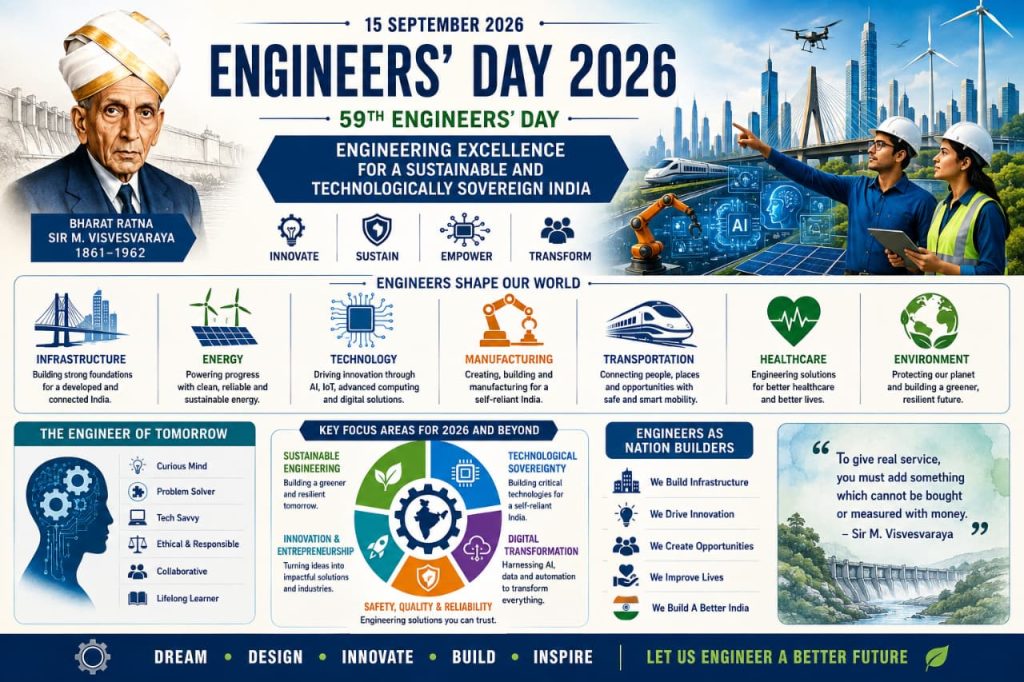
“Engineers’ Day 2026 – Engineering Excellence for a Sustainable and Technologically Sovereign India”
From Visvesvaraya’s engineering vision to AI, smart infrastructure and advanced technology — engineers continue to shape India’s future.
Why Do We Celebrate Engineers’ Day?
Engineers’ Day in India is celebrated on 15 September, the birth anniversary of Sir M. Visvesvaraya, one of India’s most distinguished engineers and statesmen.
Sir Visvesvaraya was born on 15 September 1861 at Muddenahalli in Karnataka. His career demonstrated that engineering is much more than designing structures or machines. It can be a powerful instrument for improving society, strengthening infrastructure and creating economic opportunities.
His contributions included work in irrigation, water management, flood protection, infrastructure and industrial development. He was also deeply interested in economic planning and national development.
The Government of India honoured him with the Bharat Ratna in 1955.
His life remains an important reminder that engineering excellence requires discipline, innovation, practical thinking and a commitment to society.
From Smart Engineering to Intelligent Engineering
When the 55th Engineers’ Day was celebrated in 2022, the theme was “Smart Engineering for a Better World.”
The emphasis was on digitisation, data, automation, smart infrastructure, sustainability and inclusive development.
Four years later, those ideas have moved considerably further.
Today, engineering is increasingly becoming intelligent, connected and data-driven.
Artificial intelligence can assist engineers in design, simulation, prediction and decision-making.
Sensors and the Internet of Things can monitor infrastructure in real time.
Digital twins can provide virtual representations of physical assets.
Robotics and automation are changing manufacturing.
Advanced materials are opening new possibilities in construction, transportation, energy and healthcare.
The engineer of today therefore needs not only technical knowledge, but also the ability to work with data, digital systems and multidisciplinary teams.
What Does Technological Sovereignty Mean?
Technological sovereignty does not mean working in isolation from the world.
It means developing the capability, knowledge, infrastructure and human resources necessary for a nation to design, develop, manufacture, maintain and secure critical technologies.
This becomes particularly important in areas such as:
- Semiconductors and electronics
- Artificial intelligence
- Cybersecurity
- Telecommunications
- Renewable energy
- Energy storage
- Defence technologies
- Advanced manufacturing
- Biotechnology
- Quantum technologies
- Critical digital infrastructure
Engineers have a central role in developing these capabilities.
Technological independence ultimately depends not only on policies and investments but also on engineering talent capable of converting ideas into reliable products and systems.
Engineering and Sustainability
Engineering excellence cannot be measured only by speed, efficiency or cost.
The question increasingly is:
Can we develop solutions that remain useful, affordable and environmentally responsible for generations?
Climate change, water scarcity, pollution, waste management, urban congestion, energy security and resource constraints are engineering challenges as much as environmental challenges.
Engineers therefore have an important responsibility to design systems that:
- Use resources efficiently
- Reduce waste
- Minimise environmental impact
- Improve energy efficiency
- Increase resilience against climate-related risks
- Support renewable energy
- Promote sustainable transportation
- Improve water management
- Enable responsible use of technology
The future requires engineering solutions that balance performance, affordability, sustainability and social responsibility.
AI Is Changing the Engineering Profession
Artificial intelligence is likely to become one of the most significant technological forces affecting engineering.
AI can help engineers:
- Analyse large quantities of data
- Detect defects
- Predict equipment failures
- Optimise designs
- Improve energy efficiency
- Simulate complex systems
- Automate repetitive activities
- Support project planning
- Improve quality control
- Accelerate research and development
But AI does not eliminate the need for engineers.
Instead, it changes the nature of engineering work.
The engineer of the future may increasingly become a problem solver, system integrator, technology evaluator and decision-maker, working together with intelligent digital tools.
The human engineer will remain responsible for judgement, ethics, safety, context and accountability.
Engineering Excellence Requires More Than Technology
Technology alone cannot create engineering excellence.
A technically sophisticated solution can still fail if it ignores:
People. Safety. Cost. Ethics. Environment. Reliability. Accessibility.
This is why engineering education and professional development must give greater attention to:
- Critical thinking
- Communication
- Project management
- Ethics
- Sustainability
- Leadership
- Interdisciplinary collaboration
- Data literacy
- Continuous learning
Sir Visvesvaraya’s example is particularly relevant here.
His legacy was not simply about engineering projects. It was about using knowledge and disciplined execution for national development.
Engineers as Nation Builders
Every engineer contributes to nation-building in some way.
A civil engineer creates infrastructure.
A mechanical engineer improves machines and manufacturing systems.
An electrical engineer strengthens power systems.
A computer engineer develops digital solutions.
An electronics engineer contributes to communications and semiconductor technologies.
An environmental engineer helps protect natural resources.
A chemical engineer contributes to industrial and energy processes.
A biomedical engineer connects engineering with healthcare.
An aerospace engineer expands the boundaries of transportation and space technology.
Today, the boundaries between engineering disciplines are increasingly disappearing.
The major challenges of the future will require teams rather than isolated disciplines.
The Engineer of Tomorrow
The engineer of tomorrow will need to be comfortable working at the intersection of:
Engineering + AI + Data + Sustainability + Business + Society
A successful engineer will not only ask:
“Can we build it?”
The more important questions will be:
“Should we build it?”
“Who will benefit from it?”
“Is it safe?”
“Is it sustainable?”
“Can it be maintained?”
“Can it be scaled?”
“Can it remain useful in the long term?”
This broader perspective is what can turn technical excellence into responsible engineering excellence.
Key Takeaways
1. Engineering is changing rapidly
AI, automation, robotics, digital twins, and advanced computing are redefining engineering practice.
2. Sustainability is no longer optional
Future infrastructure must consider energy, water, materials, waste, climate resilience and long-term environmental impact.
3. Technological capability matters
India’s future technological strength will depend heavily on its ability to develop engineering talent and critical technologies.
4. Human judgement remains essential
AI can assist engineers, but responsibility, ethics, safety, and judgement remain human responsibilities.
5. Engineers are nation builders
Engineering contributes directly to infrastructure, industry, healthcare, energy, communications, transportation and national development.
6. Continuous learning is essential
The technologies used by engineers will continue to change. Engineers must therefore become lifelong learners.
7. Excellence must include responsibility
Engineering success should be measured not only by technical performance but also by its impact on people and the environment.
A Message to Young Engineers
To young engineers beginning their professional journey:
Do not restrict yourself to obtaining a degree.
Learn how things work.
Learn how to solve problems.
Learn to work with people.
Learn new technologies.
Understand business and society.
Develop the courage to question existing methods.
Most importantly, develop the discipline to complete what you start.
The technologies of the future may be very different from those of today, but the fundamental qualities of a good engineer will remain the same:
Curiosity. Integrity. Competence. Creativity. Discipline. Responsibility.
Engineers’ Day 2026: A Thought for the Future
Sir M. Visvesvaraya belonged to an era when engineering was transforming a developing India through irrigation, water management, infrastructure, and industrialisation.
Today’s engineers are working in a completely different technological environment.
Yet the underlying objective remains unchanged:
Use knowledge to solve real problems and improve human life.
The challenge for today’s generation is to combine engineering excellence with sustainability and technological capability.
India needs engineers who can design not merely for today, but for tomorrow.
It needs engineers who can combine innovation with responsibility, technology with humanity, and excellence with sustainability.
That is the real meaning of Engineers’ Day.
Frequently Asked Questions — Engineers’ Day 2026
Q1. When is Engineers’ Day celebrated in India?
Engineers’ Day is celebrated every year on 15 September in India.
Q2. Why is Engineers’ Day celebrated on 15 September?
15 September is the birth anniversary of Sir Mokshagundam Visvesvaraya, one of India’s most celebrated engineers and statesmen.
Q3. Which Engineers’ Day will India celebrate in 2026?
India will celebrate the 59th Engineers’ Day in 2026.
Q4. What is the theme of Engineers’ Day 2026?
The 2026 theme is:
“Engineering Excellence for a Sustainable and Technologically Sovereign India.”
Q5. Who was Sir M. Visvesvaraya?
Sir Mokshagundam Visvesvaraya was an eminent Indian engineer, administrator, and statesman. His work in water management, irrigation, infrastructure and industrial development made a lasting contribution to India.
Q6. When did Sir M. Visvesvaraya receive the Bharat Ratna?
He was awarded the Bharat Ratna in 1955 in recognition of his outstanding contribution to the nation.
Q7. What is the role of engineers in sustainability?
Engineers design and improve systems involving energy, water, transportation, buildings, manufacturing, waste management, and infrastructure. They therefore play a major role in developing sustainable and climate-resilient solutions.
Q8. Will artificial intelligence replace engineers?
AI is more likely to transform engineering work than eliminate the engineering profession. Engineers will increasingly use AI as a tool for analysis, design, prediction, optimisation and decision-making while retaining responsibility for judgement, safety and ethics.
Q9. Why is technological sovereignty important for India?
Technological sovereignty helps a country develop the capability to design, manufacture, maintain and secure critical technologies and infrastructure. Engineers are central to building this capability.
Q10. What is the most important quality of a good engineer?
Technical competence is essential, but a truly good engineer also needs integrity, problem-solving ability, continuous learning, responsibility, and concern for society.
Happy Engineers’ Day 2026!
Let us celebrate not only the engineers who build machines, bridges, software, factories and infrastructure, but also those who solve problems, create opportunities and help society move forward.
Let the legacy of Sir M. Visvesvaraya inspire a new generation of engineers to build an India that is:
Innovative. Sustainable. Resilient. Inclusive. Technologically capable.
Happy Engineers’ Day! Let us engineer a better future